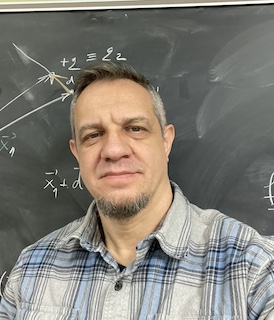
Zoltán Toroczkai is Professor of Physics and Concurrent Professor of Computer Science and Engineering at the University of Notre Dame. His research bridges nonlinear dynamics, complex systems, discrete mathematics, and the physical foundations of computing, with a particular focus on analog approaches to hard optimization problems. Together with Mária Ercsey-Ravasz, he demonstrated that NP-hard constraint satisfaction problems can be mapped onto continuous-time analog dynamical systems in which optimization hardness emerges as transient chaos (Nature Physics, 2011; cover article). He has also made foundational contributions to the network science of brain cortical connectivity (Science, 2013; Neuron, 2018). Prior to Notre Dame, he was a Director-Funded Fellow and Deputy Director of the Center for Nonlinear Studies at Los Alamos National Laboratory. He is a Fellow of the American Physical Society, holds an Erdős number of 2 and has authored over 100 peer-reviewed publications in Nature, Science, PRL, PNAS, and related journals.
Abstract: Deterministic, history-weighted gradient flow for global optimization
Many real-life problems — from combinatorial optimization and constraint satisfaction to inference in energy-based AI models — share a common mathematical structure: finding configurations that minimize a complex, non-convex energy landscape. Boolean satisfiability SAT (or MaxSAT), canonical NP-complete (or NP-hard) problems, exemplify this class: the task is to find assignments of Boolean variables satisfying the maximum number of logical constraints. Despite their ubiquity, no efficient algorithm is known for these problems in the worst case. We show that this broad class of problems admits a unified treatment through continuous-time dynamical systems (CTDS) in the form of ordinary differential equations. Our analog solver operates as an energy-based reasoning machine; however, instead of performing static gradient descent, it generates a deterministic, history-weighted gradient flow on a dynamically evolving energy landscape. Unsatisfied constraints accumulate exponentially growing tension via auxiliary variables, continuously reshaping the effective landscape and enabling escape from spurious local minima — a mechanism fundamentally distinct from both standard gradient descent and stochastic Langevin dynamics. Hardness in this framework appears as transient chaos governed by a chaotic repeller. We will briefly discuss the mathematical foundations of analog, continuous-variable computation in continuous time — its advantages, and limitations. We then present CTDS variants, some inspired by experimentally observed many-body neuronal interactions and discuss implications for energy-based AI reasoning, where the same history-weighted dynamics may offer a principled alternative to stochastic sampling for inference in learned energy landscapes.